THE BOND MARKET REFUSED ITS TRADITIONAL CRISIS ROLE

April 2026. Yields rose when they should have fallen. This is what committed capital looks like now.

YIELDSHIELD AURUM

4/21/20264 min read

The Sovereigns Moved First. Is Your Portfolio Catching Up?

The sovereigns moved first.

Central banks accumulated more gold in 2023 and 2024 than at any point since Bretton Woods collapsed. Australia committed 3% of GDP to defence. Beijing restructured its entire energy stack at national scale.

These are not forecasts. These are confirmed policy decisions being made by the institutions that hold the global monetary system together.

Then in April 2026, a geopolitical shock hit markets. Yields rose when they should have fallen. The bond market refused its traditional crisis role. The playbook that protected portfolios for decades did not show up.

The April edition of YieldShield Insider connects what the sovereigns are doing, what the bond market just signalled, and what it means for committed capital that was built for a different set of assumptions.

If your portfolio is still priced for resolution, this is the edition to read.

There is a pattern worth paying attention to right now. Not a forecast, not a model, a sequence of confirmed decisions being made at sovereign scale, in real time, that most portfolios have not yet priced.

Start with gold. The world's central banks bought more gold in 2023 and 2024 than at any point since the collapse of Bretton Woods in 1971. These are not speculative trades. These are sovereign balance sheets, the very institutions that hold the global monetary system together, quietly hedging against it. When the stewards of the system start diversifying away from it, that is not a footnote. That is a signal.

Then look at what happened in early April. Australia committed 3% of GDP to defence spending by 2033, $53 billion in additional outlays, explicitly framed around rising global conflict. Beijing, simultaneously, cut fuel output and restructured its domestic energy stack in direct response to the Gulf shock. Two sovereigns, two very different responses to the same structural break. Neither decision gets unwound in a quarter.

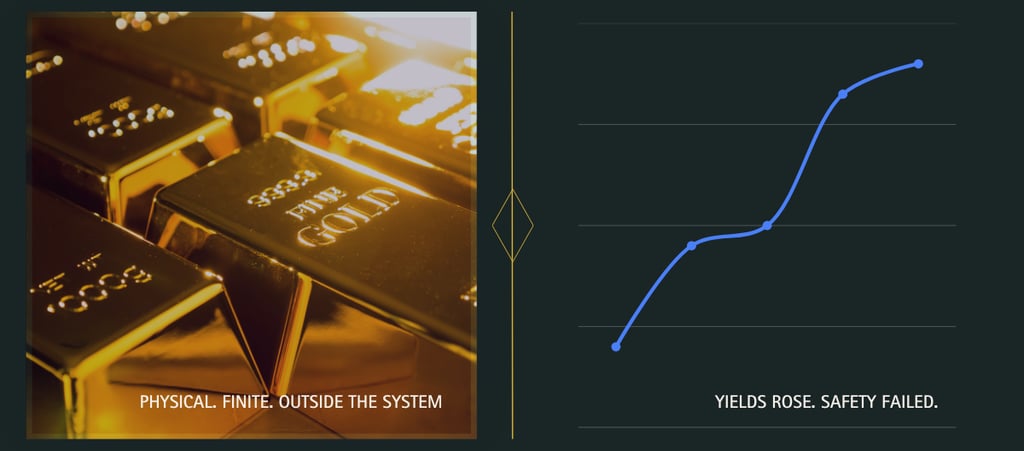
Gold sits outside the system of promises that paper assets represent. In April 2026, as geopolitical shock hit markets, bond yields rose when they should have fallen. The divergence is not noise. It is the signal.

What Structural Indifference Actually Looks Like

When the Safe Haven Stops Being Safe

Here is where it gets harder to ignore.

A geopolitical shock of genuine magnitude, the largest oil supply disruption in the history of the global market per the IEA, should have driven capital into US Treasuries. That is the historical playbook. Uncertainty spikes, investors buy bonds, yields fall.

That is not what happened.

Yields rose. Treasury auction demand recorded its worst three-week showing since May 2024, at precisely the moment safe-haven flows should have been strongest. Markets priced inflation fear ahead of safety. The bond market refused its traditional crisis role.

For investors who have spent decades building portfolios around the assumption that bonds provide ballast when equities wobble, this inversion deserves serious attention. It is not a temporary dislocation. It reflects something more structural, a market that no longer fully trusts the inflation outlook, the debt trajectory, or the crisis-absorption capacity it once took for granted. The US faces roughly $10 trillion in debt to roll over this year. The timing could not be more complicated.

The allocators who will look back on this period without regret are not adding beta. They are not extending duration. They are moving into strategies that are structurally indifferent to market direction.

This is precisely the environment YieldShield Aurum was built for, not as a reaction to current events, but because the underlying structure was designed around a different set of assumptions from the start.

Your principal is protected by an insurance policy in your name, placed directly with a leading US carrier. The income is contractual and fixed monthly, not correlated to equity performance, not sensitive to rate movements, not dependent on the old assumptions holding. It is generated from 20 years of continuous gold operations, by a borrower with two decades in the sector, using credit extended against their own assets.

The gold connection matters here beyond the obvious. Central banks are not accumulating gold because they expect a good quarter. They are accumulating it because gold sits outside the system of promises that paper assets represent. YieldShield Aurum's income derives from physical gold production, the same asset class sovereigns are quietly moving toward, for the same structural reasons.

There is no 2-and-20. No fund structure. No market exposure. Your principal never reaches the borrower. At maturity, the default is to roll. If you choose to exit, 90 days written notice prior to term end is required. This is a structure built for committed capital, not short-term repositioning.

The Question Worth Sitting With

The sovereigns are not reacting to headlines. They are pricing duration, making decisions that reflect where the structural pressures are leading over years, not quarters. Central bank gold accumulation, defence rearmament at 3% of GDP, energy stack restructuring at national scale, these are not cyclical responses. They are permanent repositioning.

The portfolio still priced for resolution, for a return to stable energy flows, predictable bond behaviour, and inflation within the old range, is not priced for the environment the sovereigns are already navigating.

The question is not whether the world has changed. The data confirming it is arriving now.

The question is whether your capital structure has.

If what you've read here is already different from anything you've seen before, that instinct is correct.

Let's talk privately.

YieldShield Insider. The conversation your portfolio needs.