Concentric circles of light on a dark blue background

What It Looks Like When the Structure Holds

The July edition of YieldShield Insider completes a three-month argument about what a genuinely fixed, contractually protected alternative looks like: instrument, interest, protection, validation, custody, correlation - examined properly rather than marketed loosely.

STRUCTURECORRELATIONDUE DILIGENCE
7/23/20263 min read

What It Looks Like When the Structure Holds

Not every allocator is the right fit.

If you need daily liquidity, this isn't it. If your mandate requires GIPS-compliant performance history, this won't satisfy it. If you evaluate structures primarily through the lens of AUM, manager tenure, or peer comparison, the conversation will stall early.

But if you are managing a treasury sleeve that needs contractual fixed income, full principal protection, and zero correlation to public markets, and you are prepared to evaluate a structure on its legal mechanics and insurance architecture, rather than its historical returns, this is a conversation worth having.

The allocators who fit tend to know within the first exchange. The questions they ask are different. They go to the contract, to the policy, to the custodial sequence. They don't ask how it compares to other private credit funds, because they've already understood it isn't one.

Three months of argument has been building toward a simple point: the right structure, evaluated properly, looks nothing like what most of the private credit conversation describes.

It looks like this.

YieldShield Insider. The conversation your portfolio needs.

A fixed interest rate and a projected return are not the same thing.

A named insurance beneficiary and a promised protection mechanism are not the same thing.

A direct bilateral loan and a private credit fund are not the same thing.

Three months ago, most of those distinctions weren't part of the conversation.

They are now.

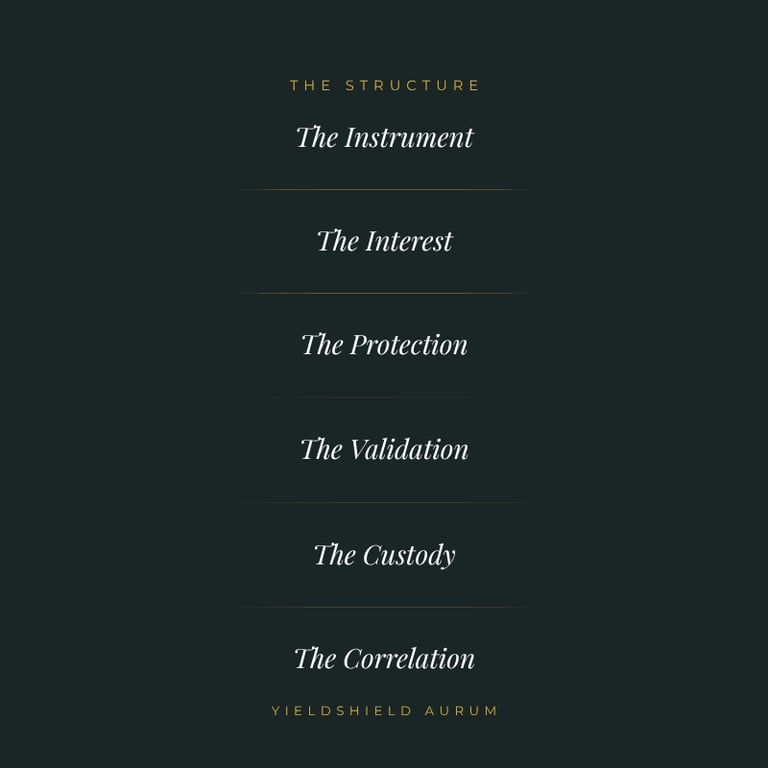
Six questions. Six answers. One structure built to hold all of them.

What the May edition established

What the structure actually looks like

The $1.3 trillion private credit market has been one of the most crowded trades of the past three years. Most of it floats. When benchmark rates were at 5%, floating income looked like fixed income. As rates declined, the income followed, because the structure was always tied to an environment, not a contract.

The May edition made one argument: the category label and the instrument are not the same thing. An allocator who entered private credit expecting stable, contractual income owns something different than they thought, not because they were misled, but because the distinction was never the headline.

What the June edition asked

Six questions. Each one a scalpel.

What kind of instrument is it, actually? Who holds the protection, and is the investor the direct named beneficiary? What does a Tier 1 insurer's willingness to underwrite tell you that a three-year track record cannot? What does non-correlation mean as a structural fact rather than a marketing claim? And, are you the right fit for this kind of structure at all?

Those questions were not rhetorical. They were a framework for evaluation. The allocators who asked them properly arrived at a shorter list of structures that could answer them properly.

Who this is for

This is that answer.

The instrument. Fixed. Contractual. Not tied to SOFR, not tied to a benchmark, not subject to rate-environment drift. The rate is the rate because the loan agreement says so. It wires to the investor's designated account within seven days of each executed monthly transaction. There is no projection involved. There is no estimate. There is a defined obligation and a defined payment sequence.

The protection. A principal insurance policy issued directly in the investor's name by a Tier 1 US carrier before a single dollar moves. Not a fund-level guarantee. Not a stop-loss. Not a structural feature that depends on market conditions to hold. The investor is the named beneficiary. The trigger is defined. The mechanism is the policy itself, not a promise adjacent to it.

The validation. The insurer underwrote this. That is not a minor detail. Tier 1 carriers don't underwrite as a favour. They price risk for a living, they bear the consequence if they're wrong, and their internal standards are in many ways more demanding than a standard institutional due diligence process. Their participation is a data point that three years of track record cannot replicate.

The custody. Institutional-grade. BDO-audited. FSC-regulated. The custodial sequence is traceable. The investor can follow their principal from execution through each monthly cycle. There is no opacity in the mechanics, only in the counterparty names, which are not disclosed publicly for circumvention reasons and are available through the structured due diligence process.

The correlation. The fixed contractual rate doesn't move when equities reprice. It doesn't compress when credit spreads widen. It isn't marked to market. It isn't NAV-dependent. That is non-correlation as a structural consequence of the instrument's legal nature — not as a marketing claim built on historical data.

The July edition of YieldShield Insider completes the argument. three months, six questions, one answer.

YieldShield Insider | July 2026

Accredited investors only. All inquiries by written request only.

©2026 Wellcome Capital Consulting Inc. | Incorporated in Alberta, Canada. All rights reserved.

Content for informational purposes only. Not legal, tax, or investment advice Privacy Policy

YieldShield Aurum is the branded name used by Wellcome Capital for a direct bilateral loan agreement between an accredited investor and the borrower counterparty, supported by a principal protection insurance policy issued directly to the investor by an assigned insurance carrier. The borrower is an independent Nevis-registered private wealth-lending platform. Monthly interest is paid directly by the borrower. Principal protection is provided by the investor's insurance carrier under the terms of the policy. Wellcome Capital acts solely as marketing and introduction partner. It is not a counterparty to the loan or the insurance policy, and bears no liability for capital, interest or insurance obligations. All contractual obligations rest with the borrower and the assigned insurance carrier respectively. For informational purposes only. Not investment advice. For accredited investors only