Hand reaching towards floating percentage symbols.

When "Private Credit" Doesn't Mean Fixed Income

Private credit has reshaped fixed income but most of it floats.

FIXED INCOMEYIELDSHIELD AURUM

5/19/20262 min read

There is a difference between private credit and fixed income that most fund presentations prefer you don't examine too closely. One fixes the rate. The other ties it to a benchmark and calls it income. As rate cuts continue and income compression becomes harder to ignore, that distinction matters more now than it did a year ago.

When "Private Credit" Doesn't Mean Fixed Income

The $1.3 trillion private credit market has been one of the most crowded trades of the past three years. Institutional capital poured in. Family offices followed. The pitch was consistent: higher yield than bonds, less volatility than equity, non-correlated income.

Most of that pitch was accurate. What it didn't always say clearly is that most private credit income isn't fixed. It floats.

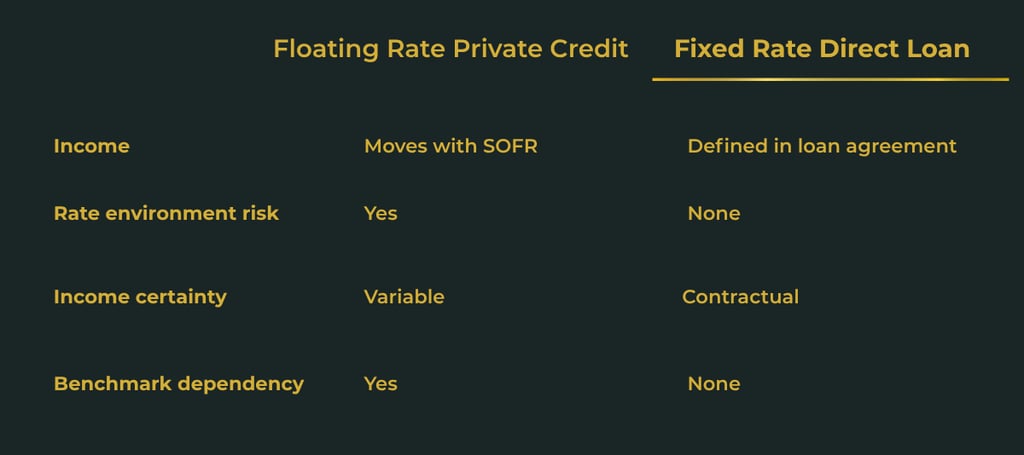
The majority of direct lending strategies are built on floating-rate loans: coupons tied to SOFR plus a spread. When benchmark rates were at 5%, that looked like yield. As rates decline, that income follows. The structure didn't change. The environment did.

Private credit has reshaped fixed income. But most of it floats. YieldShield Insider | May 2026 - when the instrument matters more than the category.

The distinction most fund presentations prefer you don't examine too closely.

This matters more than it appears on a fund presentation. An allocator who entered a floating-rate private credit fund expecting stable, predictable income is now managing a different instrument than the one they thought they owned. Not because they were misled, but because the distinction between floating income and fixed income was never the headline.

There is a second issue emerging alongside income compression. As base rates fall and spread compression follows, some managers are reaching for higher-spread, lower-quality borrowers to maintain headline yield. The income number stays similar. The underlying risk profile doesn't.

A third dynamic is worth naming. Structures that have grown alongside the private credit boom: covenant-lite documentation, payment in kind income, NAV-based lending, layered fund-level leverage; make it increasingly difficult to assess where the actual risk sits. The headline yield is visible. What's supporting it is less so.

This is not an argument against private credit as a category. It is an argument for precision in what you mean when you say fixed income alternative.

A fixed contractual interest rate, defined in a loan agreement, not tied to a benchmark, not subject to rate-environment drift; is a different instrument. It doesn't benefit from rising rates. It doesn't suffer from falling ones. The rate is the rate because the contract says so, not because SOFR says so.

That distinction is becoming more relevant, not less, as the rate environment continues to evolve and as the structures that delivered attractive floating income in a high-rate world begin to show the limits of that design.

The allocators who understood this distinction before it became a problem are the ones whose income sleeve is performing exactly as planned.

YieldShield Insider. The conversation your portfolio needs.